



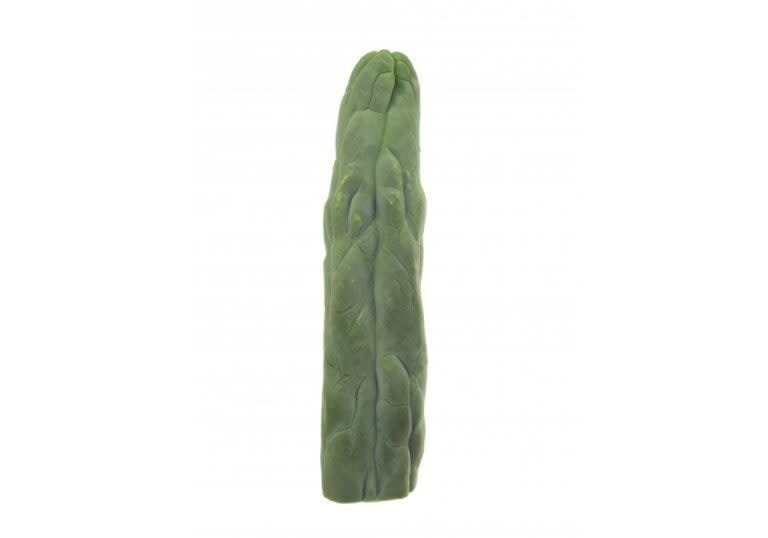
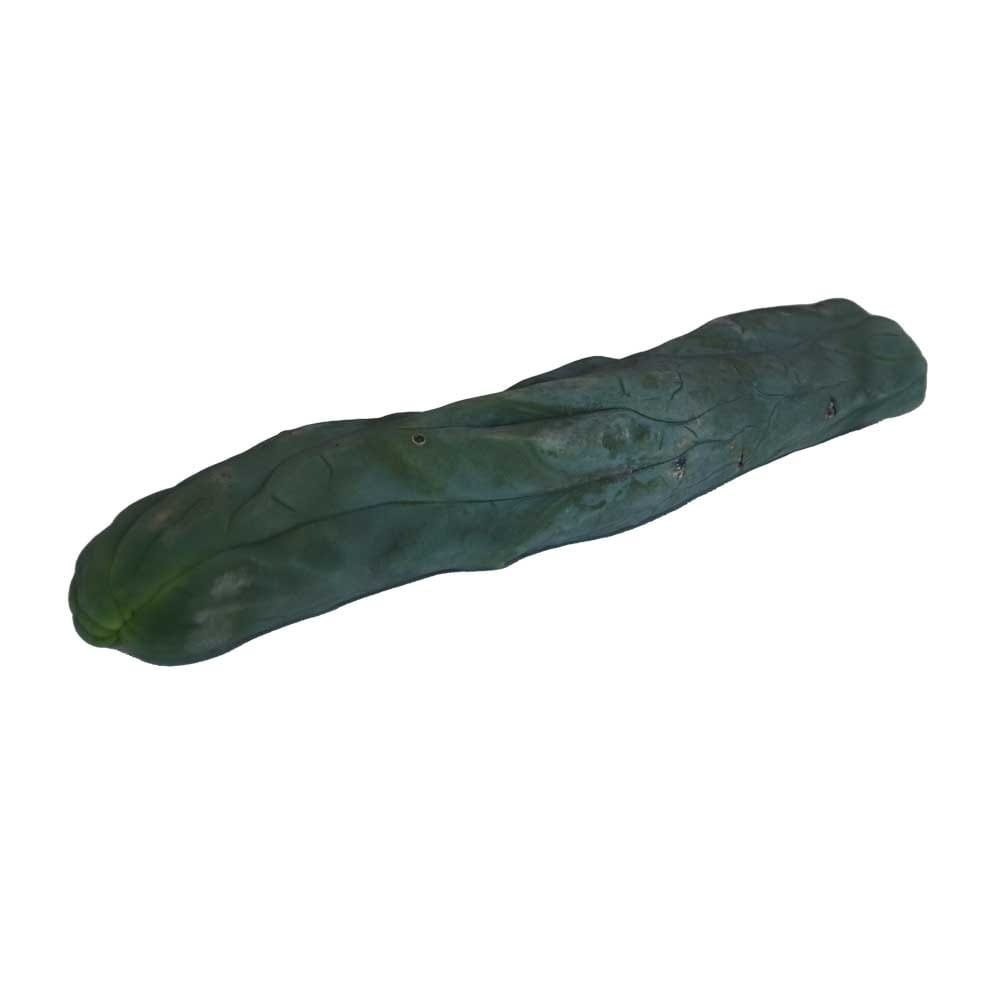

1. San Pedro Cutting Monstrosus — 25 cm
Most columnar cacti are predictable: symmetrical ribs, even growth, the same silhouette every time. Trichocereus pachanoi f. monstruosa (syn. Echinopsis pachanoi f. monstruosa) is none of that, and that is the entire point of owning one.
This is a naturally occurring mutation that disrupts normal rib development, producing a swirling, knobby, asymmetrical form that looks more sculpted than grown. No two specimens are the same, which is unusual enough in horticulture to be worth saying plainly.
It is not a novelty dressed up as a collector’s piece either. The monstrose form is a documented morphological divergence — the Llifle Cactus Encyclopedia carries an entry for Trichocereus pachanoi f. monstruosa — and serious growers have prized it for decades precisely because of its unpredictability.
Legal status: Mescaline is a controlled substance in the Netherlands and most other countries. Living Trichocereus plants and cuttings are sold legally as ornamental horticulture, which is what this is. Extracting or preparing mescaline from one is not legal. Check your local law before ordering.
2. Specifications
| Specification | Detail |
|---|---|
| Scientific name | Trichocereus pachanoi f. monstruosa (syn. Echinopsis pachanoi f. monstruosa) |
| Common name | Monstrose San Pedro |
| Cutting length | 25 cm |
| Price | €34.95 |
| Form | Irregular, knobby, asymmetrical — every specimen differs |
| Underlying species | Echinopsis pachanoi, the standard San Pedro |
| Alkaloid | Mescaline, as with any pachanoi |
| Callusing period | 1 to 3 weeks dry before planting |
| Growth rate | Slower and less predictable than the standard form |
| Documented in | Llifle Cactus Encyclopedia, as f. monstruosa |
| Age restriction | 18+ only |
3. What a monstrose mutation actually is
“Monstrose” and “crested” get used interchangeably by sellers and they are not the same thing. The distinction is worth knowing before you spend collector money:
| Form | What has happened |
|---|---|
| Normal | A single growing point at the tip produces regular ribs in a predictable spiral. This is what an ordinary San Pedro does. |
| Monstrose | The growing points multiply and appear irregularly across the body rather than only at the tip. The result is lumpy, asymmetrical and different on every plant — which is this cactus. |
| Crested (cristate) | The single growing point stretches into a line rather than a point, producing fan- or brain-like ridges. A different mutation with a different look. |
3.1 What it means for growing
- It grows more slowly. Disordered growing points are less efficient than one well-organised one. Expect less than the 15 to 30 cm a year a standard pachanoi manages.
- It grows unpredictably. Where a new branch appears is not something you can plan around.
- It can partly revert. Monstrose plants sometimes throw a normal, regular section. That is not a defect and it is not reversible by anything you do.
- Care is otherwise identical to a standard San Pedro cutting: gritty free-draining mix, bright light introduced gradually, soak-and-dry watering, and a completely dry winter rest.
- It is chemically the same plant. The mutation affects form, not species — this is pachanoi.
4. Callusing and care
4.1 Callus it before you plant it
- Stand it dry, cut end down, somewhere warm, shaded and airy. Not in a sealed box.
- Leave it one to three weeks until the cut face is dry and hard across its whole surface.
- No water, no misting, no soil during that period. The cutting lives off its own reserves.
- Then plant it two to three centimetres deep in a gritty mix, with support if the irregular shape means it will not stand square.
- Wait another week to ten days before the first watering.
4.2 Afterwards
- Light: bright, built up gradually over two to three weeks after transit.
- Water: soak and dry, only when the soil is dry all the way through.
- Winter: dry, bright and frost-free from October.
- Support: monstrose growth is often top-heavy and lopsided. A cane is not an admission of failure.
Monstrose means many growing points instead of one. Crested means one growing point stretched into a line. Sellers use the words interchangeably; the plants look nothing alike.
- A 25 cm cutting of Trichocereus pachanoi f. monstruosa — the monstrose San Pedro.
- A documented morphological form, not a novelty. Every specimen is genuinely different.
- Slower and less predictable than the standard form; partial reversion to normal growth is normal.
- Callus it dry for one to three weeks before planting, then wait again before the first watering.
- Chemically the same plant as any pachanoi: care is identical.
- Sold as ornamental horticulture; mescaline is controlled. 18+ only.
- Order before 16:00 on weekdays for same-day dispatch in plain, unmarked packaging.
 Premium ingredients for optimal results