

1. Peyote cactus 5 — 7 cm
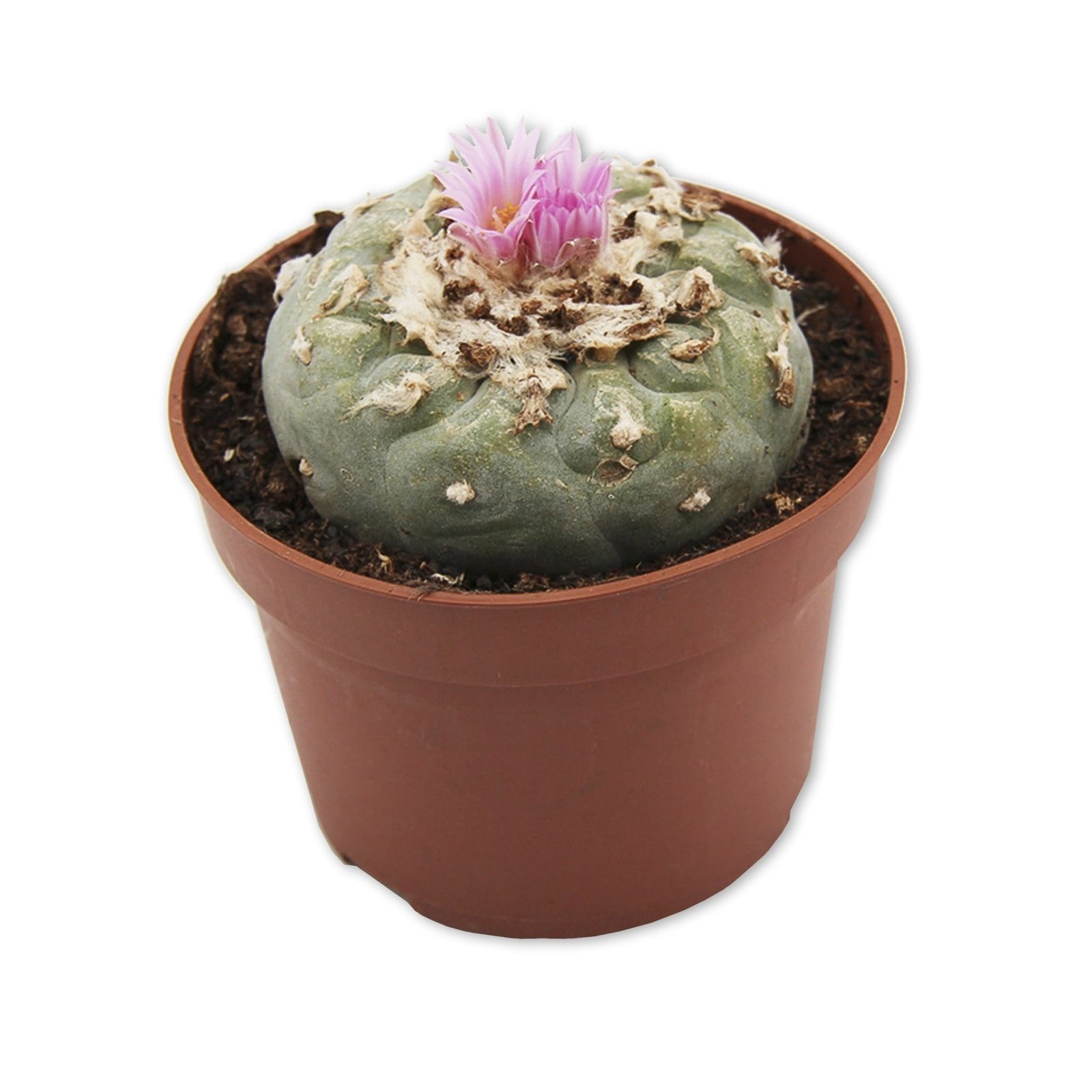
A specimen at this size does not come around often. This is a 100% own-root Lophophora williamsii, never grafted and never rushed, grown from seed over ten to fifteen years or more into a dense, glaucous crown with a fully developed napiform taproot.
What you get is a plant that earned its diameter through time rather than through a foreign rootstock. Grafted plants reach 5 to 7 cm in three to five years; the structural character is not comparable, and anyone who has handled both can tell them apart immediately.
Ships bare-root and protected, EU-wide, direct to your door. Order before 16:00 and it leaves today.
Legal status: Keeping and growing a living peyote plant is legal in the Netherlands, Germany and the UK; extracting or consuming it is not, since mescaline is a controlled substance. We supply these plants for ornamental and botanical purposes exclusively. Lophophora williamsii is listed under CITES Appendix II.
2. Specimen data
| Specification | Detail |
|---|---|
| Scientific name | Lophophora williamsii |
| Common names | Peyote cactus, button cactus |
| Crown diameter | 5 to 7 cm — mature adult, flowering size |
| Estimated age | 10 to 15+ years, own-root and seed-grown |
| Price | €69.95 |
| Root system | Fleshy napiform taproot, 6 to 12 cm — never grafted |
| Growth form | Spineless, blue-green to grey-green globose stem with woolly areoles |
| Flower | Solitary pink or pale white, 1.5 to 2.5 cm, from the woolly crown centre |
| Substrate | 90% mineral (pumice, lava rock, coarse grit) to 10% organic soil |
| Pot | Deep, narrow, unglazed terracotta with large drainage holes |
| Watering (March to September) | Soak and dry — water through, then wait until bone-dry |
| Winter dormancy | From October, no water at all; cool and frost-free at 5 °C to 10 °C |
| Light | Bright indirect year-round; direct sun only after gradual adaptation |
| Provenance | 100% legally propagated from seed, CITES Appendix II compliant |
| Shipping | Bare-root and soil-free in protective packaging, guaranteed safe arrival |
3. Botanical specifications
3.1 Form
This is a small, spineless, button-shaped glaucous succulent from the arid stretch running through northern Mexico into southern Texas. No spines, no dramatic silhouette. What it offers instead is a quietly architectural quality: a blue-green to grey-green globose stem divided by shallow, rounded ribs, each lined with woolly areoles that give the crown its felted texture.
3.2 The taproot
Below the soil line the architecture is just as striking. The Flora of North America description gives the fleshy taproot as typically 6 to 12 cm long, often exceeding the visible crown in sheer mass, and serving as the plant’s water and nutrient reservoir through prolonged drought. Shallow pots are not merely suboptimal here: they restrict root development and create exactly the stagnant moisture that causes taproot rot. A deep, narrow, unglazed clay pot is not negotiable for long-term success.
3.3 Alkaloid distribution
One detail for collectors who read the literature: alkaloid distribution within the plant is sharply uneven. Klein et al., Haseltonia (2015) documents mescaline concentration in dried crown tissue at 1.82% to 5.50% by dry weight, against roughly 0.05% in dried root tissue. The contrast is what makes the taproot botanically significant as a structural organ rather than a chemical one. It is sometimes argued that rapid rootstock-driven growth dilutes the secondary metabolites that accumulate through slow, stress-conditioned ageing, though controlled comparisons at identical sizes remain scarce.
4. Essential care and cultivation
4.1 Substrate and pot
Standard commercial cactus mixes hold far too much moisture for this species. The taproot is adapted to drain fast and then sit dry for long periods, and a soggy substrate is the commonest cause of loss in cultivation. The recipe that works consistently is 90% mineral — pumice, lava rock and coarse grit in roughly equal parts — with 10% organic soil, which reproduces the fast-draining, nutrient-sparse conditions of the Chihuahuan Desert and lets the root zone cycle between wet and bone-dry without waterlogging.
Pot choice matters as much as substrate. Unglazed terracotta with large drainage holes lets moisture disperse through the pot wall itself and gives the taproot the aeration it needs. Glazed ceramic and plastic both trap humidity at the root zone; avoid both.
4.2 Watering, dormancy and light
Through the active season, March to September, water follows a strict soak-and-dry rhythm: water thoroughly until it drains from the base, then wait until the substrate is completely dry before the next. From October, stop entirely. Keep the plant cool and frost-free — 5 °C to 10 °C is ideal for dormancy — and do not resume until temperatures rise and new growth appears in spring.
Lighting is more nuanced than most care guides suggest. Bright indirect light works well year-round; direct sun requires gradual adaptation, particularly after the darkness of transit.
5. Provenance
There is a conservation dimension to this purchase that serious collectors already know about. Wild peyote in its native range is heavily poached, and the arithmetic is unforgiving: a decade of desert growth is removed in a moment and does not regrow on any useful timescale. Nursery propagation from seed, which is where every plant we ship comes from, takes that pressure off wild populations.
Ten to fifteen years on its own roots, or three to five on somebody else’s. The diameter is the same and nothing else is.
- A 5 to 7 cm own-root Lophophora williamsii, 10 to 15+ years old and at full flowering size.
- Fleshy napiform taproot of 6 to 12 cm — deep, narrow, unglazed pots only.
- Solitary pink or pale white flowers, 1.5 to 2.5 cm, from the woolly crown centre.
- Soak and dry from March to September; completely dry at 5 to 10 °C from October.
- Shipped bare-root and soil-free in discreet, shock-absorbing packaging, with a live arrival guarantee.
- Legal to own and grow as an ornamental in NL, DE and UK. Extraction and consumption are not. CITES Appendix II.
- Order before 16:00 on weekdays for same-day dispatch in plain, unmarked packaging.
 Premium ingredients for optimal results