
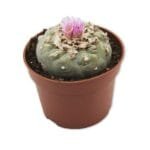
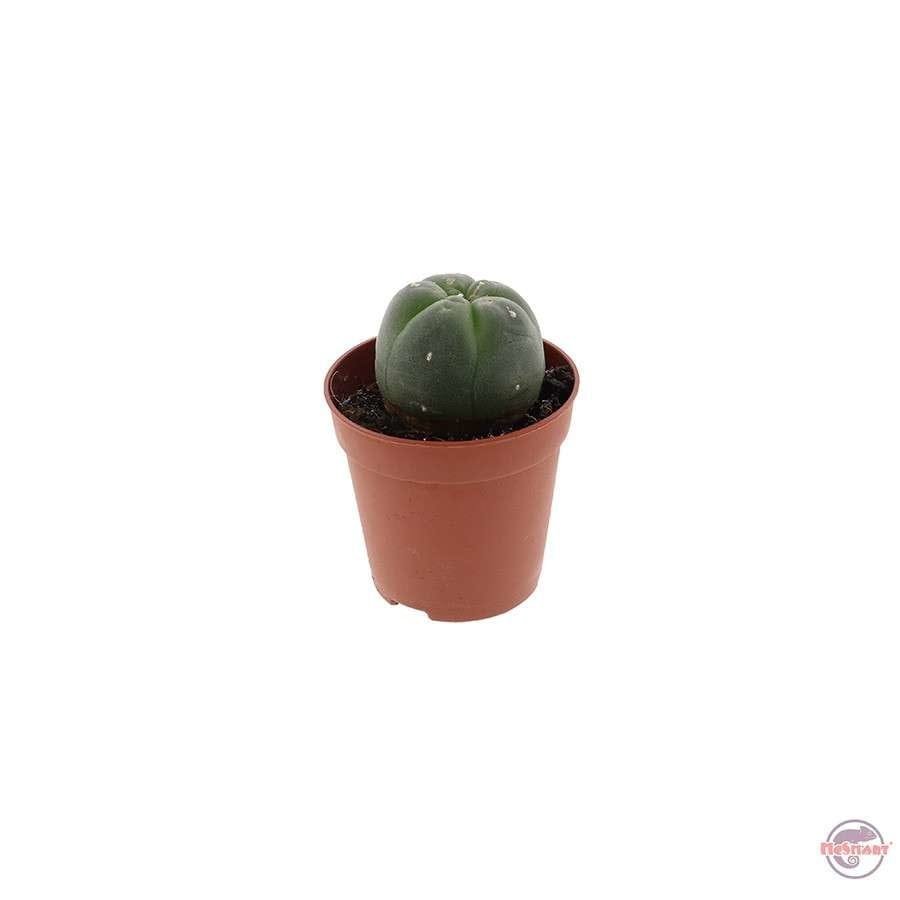
1. Peyote cactus 4 — 5 cm
Nine to ten years of careful, seed-based rearing separate a 4–5 cm Lophophora williamsii from a freshly germinated seedling, and that gap is obvious the moment you hold one. It is roughly the size of a golf ball and it feels solid, heavy and genuinely tough.
The flat-topped crown, the dense wool tufts, the compact blue-green body: these are the marks of a plant that grew at its own pace, on its own roots, with no shortcuts. At this diameter it has crossed into flowering-capable maturity, which means it is finally ready to produce the pale pink blossoms collectors wait the better part of a decade to see. It has also developed the thick, deep taproot that grafted plants never produce at all.
Every specimen we supply is nursery-cultivated from seed in Europe. That matters for authenticity, and it matters more for the wild populations covered in section 5.
Legal status: The Netherlands, Germany and the UK all permit the ownership and cultivation of live Lophophora williamsii as an ornamental cactus. Any preparation or consumption is prohibited on account of its mescaline content. Our specimens are supplied for collections and botanical interest only, and the species carries a CITES Appendix II listing.
2. Specifications
| Specification | Detail |
|---|---|
| Botanical name | Lophophora williamsii — spineless, button-forming cactus |
| Diameter | 4 to 5 cm — mature, flowering-ready |
| Age | 9 to 10 years, slow-grown from seed, never grafted |
| Price | €34.95 |
| Root system | Own root; solid, carrot-like taproot, fully developed |
| Native range | Chihuahuan Desert — parts of Texas and northern Mexico |
| Substrate | 80–90% inorganic (pumice, lava rock, coarse gravel); 10–20% organic loam at most |
| Watering (summer) | Soak and dry — roughly every 7 to 10 days, only once the soil is completely dry |
| Winter dormancy | No water at all; cool and dry, 10 °C to 15 °C |
| Light | Bright and indirect; 14 to 16 hours at moderate intensity under LEDs in the growing season |
| Temperature (growing season) | 18 °C to 30 °C |
| Provenance | 100% sustainable nursery cultivation in Europe, from seed |
| CITES | Appendix II — nursery-cultivated, not wild-collected |
| Shipping | Bare-root, breathable protective wrap, fully discreet unbranded packaging |
3. Botanical profile and growth dynamics
3.1 Why the timeline is the point
Lophophora williamsii is a spineless, button-forming cactus of the Chihuahuan Desert, across parts of Texas and northern Mexico, and its growth is extraordinarily slow. The NC State University Plant Toolbox records a maturation window of 10 to 30 years for wild specimens reaching full flowering size. In controlled nursery cultivation, a 4–5 cm own-root plant grown from seed typically takes 9 to 15 years.
Cellular density, alkaloid accumulation and root architecture all develop in proportion to that pace. The timeline is not a flaw in the cultivation process — it is the process. At 4–5 cm the crown has formed the ribbed, areole-bearing structure capable of producing the small pink flowers that precede seed pods.
3.2 Own root against grafted
Grafting onto a fast rootstock such as Trichocereus or Pereskiopsis spathulata compresses that 9-to-15-year timeline into one to three years. The acceleration is real; so are the trade-offs. Grafted specimens tend to look unnaturally bloated, spherical and bright green because of the rootstock’s aggressive water uptake, and they lack the dense trichome tufts and flattened crown profile that define the species. Most importantly they never develop a true taproot — the root tissue belongs to the host.
There is a further argument that rapid cell division dilutes alkaloid concentration by dry weight, though controlled comparisons at identical sizes remain scarce. What the research does establish is that alkaloid distribution in own-root plants follows a clear anatomical pattern: crown tissue carries by far the highest concentration, measured at 1.82% to 5.50% mescaline by dry weight, while root tissue registers a negligible 0.0147% to 0.0773% (Klein et al., Haseltonia, 2015). Own-root specimens keep that natural distribution intact.
3.3 Side by side
| Own-root cultivated specimen | Grafted specimen |
|---|---|
| 9 to 15 years to reach 4–5 cm | 1 to 3 years to the same diameter |
| Crown mescaline 1.82%–5.50% dry weight (Klein et al., 2015) | Variable, and often lower by dry weight |
| Root tissue 0.0147%–0.0773% dry weight | Not applicable — the roots are the host’s |
| Compact, flat-crowned, dense wool tufts | Bloated, spherical, bright green |
| Fully developed napiform taproot | No taproot of its own; dependent on the graft union |
| Survives independently from day one | Starting from scratch if the union fails or it is de-grafted |
4. Care in brief
- Substrate: 80 to 90% inorganic — pumice, lava rock, coarse gravel — with no more than 10 to 20% organic loam.
- Summer watering: soak and dry, roughly every 7 to 10 days, and only once the soil is completely dry throughout.
- Winter: no water at all, cool and dry between 10 °C and 15 °C.
- Light: bright and indirect; 14 to 16 hours at moderate intensity under LEDs during the growing season, introduced gradually after transit.
- Growing season temperature: 18 °C to 30 °C.
- After potting: keep it dry for the first week to fortnight before the first watering.
5. Conservation and sourcing
Buying cultivated rather than wild-collected material is not a marketing line for this species — it is the difference between a hobby and a harm. Wild Lophophora in Texas and Mexico is poached commercially, and because the plant grows so slowly, removed populations do not come back within a human lifetime. Ours are seed-grown in legal European nurseries and never leave a desert.
A 4–5 cm wild plant is roughly a decade of undisturbed desert. That is the arithmetic behind buying nursery-grown.
- A 4 to 5 cm own-root Lophophora williamsii, 9 to 10 years old and flowering-ready.
- Never grafted — a fully developed carrot-like taproot, and the compact crown that comes with slow growth.
- Crown mescaline concentration in own-root plants: 1.82% to 5.50% dry weight (Klein et al., 2015).
- Shipped bare-root and soil-free in discreet, shock-absorbing packaging, with a live arrival guarantee.
- Complete winter dormancy from October: cool, frost-free and no water at all.
- Legal to own and grow as an ornamental in NL, DE and UK. Extraction and consumption are not. CITES Appendix II.
- Order before 16:00 on weekdays for same-day dispatch in plain, unmarked packaging.
 Premium ingredients for optimal results