
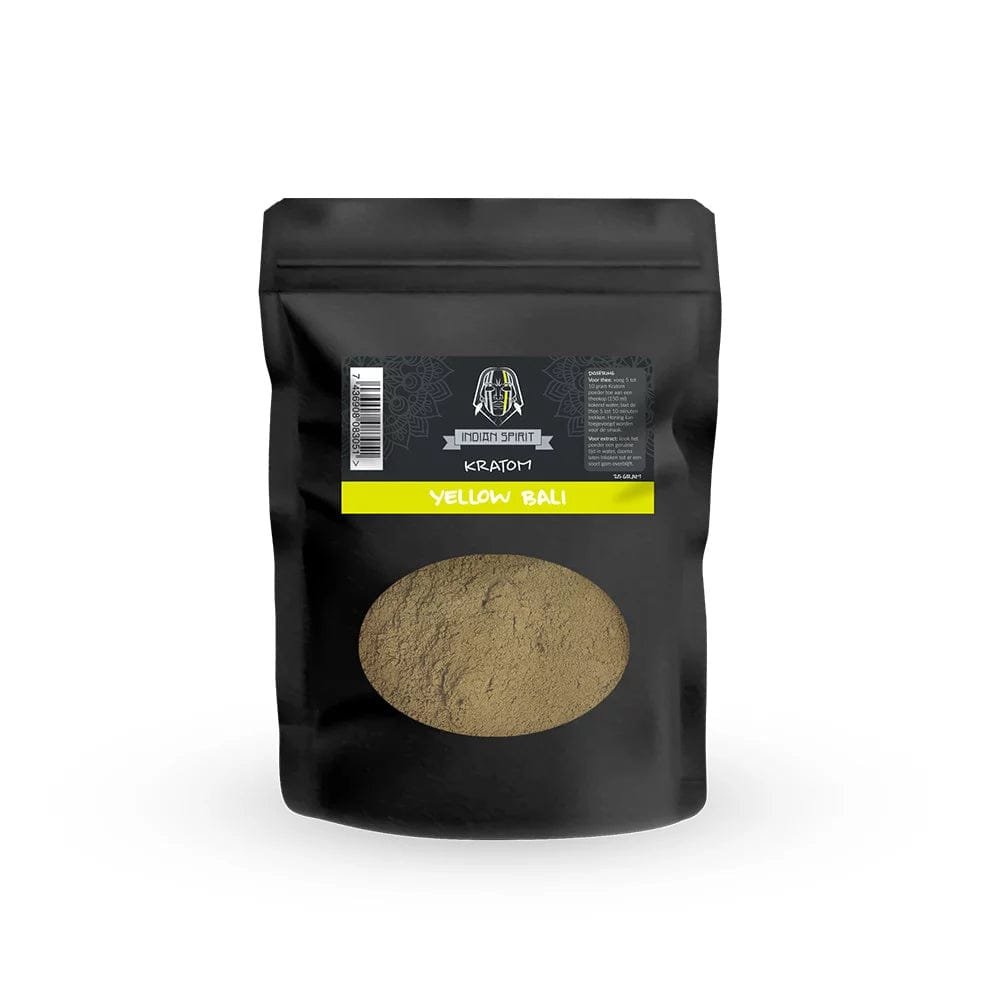
1. Indian Spirit Kratom — Yellow Bali, 25g / 50g
Loose Yellow Bali kratom powder from Indian Spirit, in 25-gram and 50-gram bags. Bali is the oldest and most established name in the kratom trade, and yellow is the processing designation applied to it here.
Yellow is not a vein colour. Kratom leaves have red, white or green veins; yellow refers to extended or modified drying, or to a blend of dried green and red. It is consistently described as sitting between the two — smoother and longer-lasting than either.
“Bali” deserves its own explanation, because it is the clearest example in the whole trade of a name that does not mean what it appears to.
Legal status: Mitragyna speciosa is legal to sell and possess in the Netherlands. It is banned or controlled in several other countries and remains under regulatory review in the EU and the United States. Check the law where you live before ordering.
2. Specifications
| Specification | Detail |
|---|---|
| Product name | Indian Spirit Kratom — Yellow Bali, 25g / 50g |
| Brand | Indian Spirit |
| Plant | Mitragyna speciosa |
| Vein type | Yellow |
| Strain | Yellow Bali |
| Form | Loose powder |
| Sizes | 25 grams and 50 grams |
| Commonly used as | A tea, 4 to 5 grams brewed |
| Onset | Around 15 minutes for a tea, lasting several hours |
| Storage | Airtight, cool, dry, out of light. Do not refrigerate |
| Age restriction | 18+ only |
3. The Bali question
This is worth knowing and almost nobody selling kratom will tell you:
- Very little kratom is grown on Bali. The island is not a significant Mitragyna speciosa growing region and never has been. Kratom comes overwhelmingly from Borneo, Sumatra and mainland Southeast Asia.
- The name is generally understood to be a shipping designation. Material was historically exported through Balinese ports, and the port name attached itself to the product.
- Which makes Bali a style rather than an origin. It describes a recognisable type of leaf and processing, widely traded and reasonably consistent, and it has meant that for decades.
- That is not a scandal, but it is worth knowing. Nobody is being defrauded — the trade has used these names openly for a very long time — but a customer reading “Bali” as provenance is reading it wrong.
- And it generalises. Most region names in kratom describe style, port or reputation as much as they describe soil. Borneo, Maeng da, Super, Premium: all trade vocabulary, none certified.
3.1 What Bali material is like
For all that, the description is stable across a great deal of reporting: Bali kratom is described as balanced and full-bodied, physically comfortable, without the sharpness of a stimulant-leaning white. Combined with yellow processing, which is itself described as smoothing and lengthening, this sits firmly in the unremarkable-in-a-good-way category.
It is a reasonable strain to keep as a default, which is more or less how it has been used for decades.
4. Using it
4.1 Brewing it
- Measure by weight, never by spoon. Powder density varies enough between grinds that a level teaspoon is not a consistent unit. Four to five grams is the common starting point.
- Hot water off the boil, stirred through properly.
- Honey or a strong juice makes the bitterness manageable.
- Sediment included if you can face it; some of the alkaloid content is in it.
- Give it an hour before any second thought. Onset is usually around a quarter of an hour.
4.2 25 grams — the trial size
Twenty-five grams is around five to six sessions at a typical amount, which is exactly the right quantity for answering one question: does this strain suit me?
- Enough to judge it properly. One session tells you very little — how you slept, what you ate and what sort of day it was all colour a single result. Five or six gives you a real impression.
- Small enough to be no loss if it does not. Strain preference is genuinely individual and nobody gets it right first time.
- The sensible way to explore. Buy two or three 25-gram bags of different strains rather than one large bag of a strain you have not tried.
- Keep notes. Strain, amount, time of day, how it went. Across three strains that record is the only thing that will actually tell you which you prefer.
- Then buy the 50-gram bag of the one that worked, which is what the size is there for.
5. Cautions
- Not for anyone under 18, pregnant or breastfeeding.
- Kratom acts on the body’s opioid receptors. Regular use can lead to tolerance, dependence and withdrawal — this is well documented and is the single most important thing to know before starting.
- Do not combine with alcohol, sedatives, opioid medication or other central nervous system depressants. This combination is where serious harm occurs.
- Do not use if you have heart, lung, liver or kidney problems, high or low blood pressure, or diabetes, without medical advice.
- Do not drive or operate machinery after use.
- Kratom is restricted or banned in several European countries and under active regulatory review elsewhere. Check your local law before ordering.
- Keep out of reach of children and pets.
Very little kratom is grown on Bali. The name is a shipping designation that stuck, and it describes a style rather than an origin.
- Loose Yellow Bali Mitragyna speciosa powder from Indian Spirit, in 25g and 50g bags.
- Yellow is a drying or blending designation, not a vein colour on the plant.
- “Bali” is a shipping name, not a growing region — kratom comes from Borneo and Sumatra.
- What it does describe is a real and consistent style: balanced, full-bodied, physically comfortable.
- A reasonable default strain, which is roughly how it has been used for decades.
- Brew 4 to 5 grams as a tea, weighed. Acts at opioid receptors. 18+ only.
- Order before 16:00 on weekdays for same-day dispatch in plain, unmarked packaging.
 Premium ingredients for optimal results