


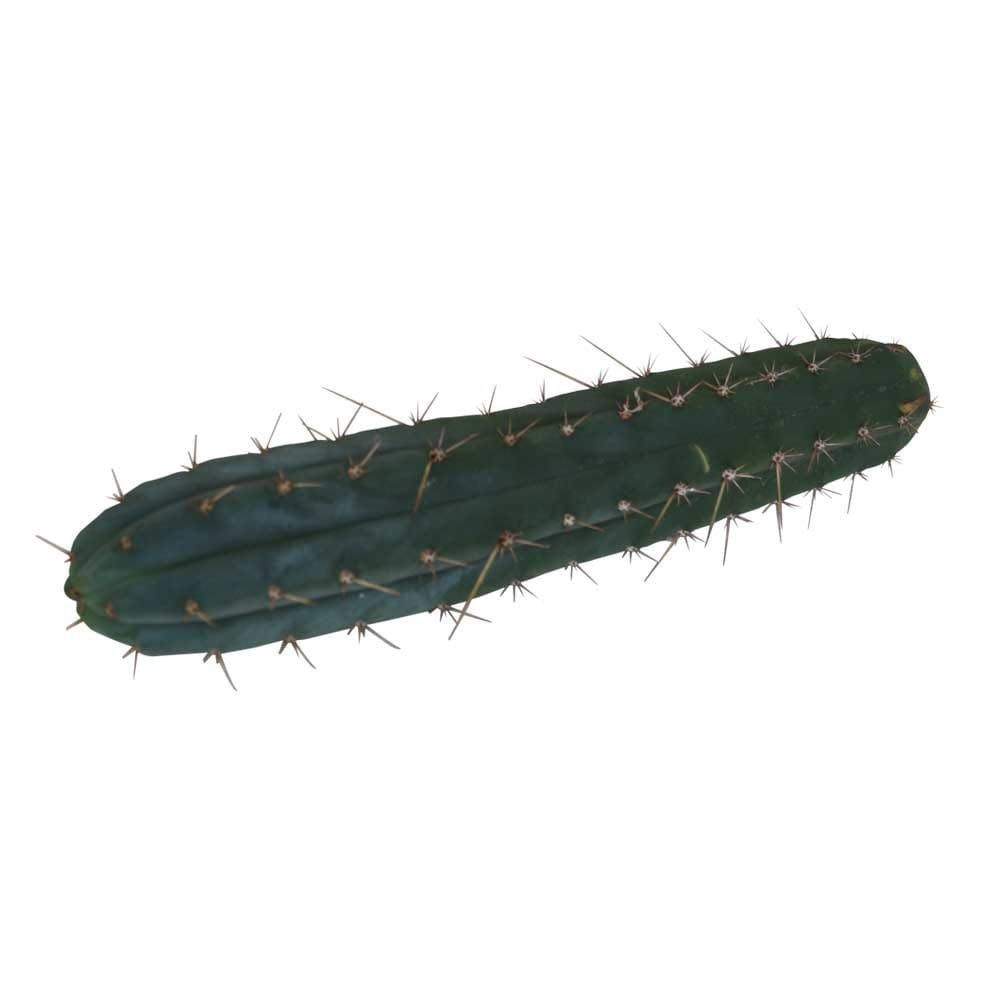
1. San Pedro Cutting Macrogona 25cm
A 25 cm cutting of Trichocereus macrogonus — and taxonomically, the most important cactus on this shelf. Kew’s Plants of the World Online recognises T. macrogonus as the anchor of the entire San Pedro species complex, which makes several of the other names in this category synonyms of it.
Visually it is one of the most commanding columnar cacti you can grow in a European climate: erect deep blue-green stems, six to nine thick rounded ribs, felted grey-brown areoles roughly 1.5 to 2.5 cm apart, and rigid needle-like spines that darken from yellow-brown at the base to near-black at the tips on mature growth.
It comes from the rocky Andes of Peru, Bolivia and Ecuador at two to three thousand metres — conditions most houseplants would not survive a week of — and the resulting hardiness is genuinely useful in a Dutch garden.
Legal status: Mescaline is a controlled substance in the Netherlands and in most other countries. Living Trichocereus plants and cuttings are sold legally as ornamental horticulture across the EU and UK, which is what this is; extracting or preparing mescaline from one is not legal. Check your local law before ordering.
2. Specifications
| Specification | Detail |
|---|---|
| Botanical name | Trichocereus macrogonus |
| Common name | San Pedro, Macrogona |
| Taxonomic note | Recognised by Kew’s Plants of the World Online as the taxonomic anchor of the San Pedro complex |
| Cutting length | 25 cm (roughly 10 inches) |
| Native range | Andes of Peru, Bolivia and Ecuador, 2,000 to 3,000 m altitude |
| Rib count | 6 to 9 thick, rounded ribs |
| Areole spacing | Roughly 1.5 to 2.5 cm apart |
| Spines | Rigid and needle-like; yellow-brown at the base, near-black at the tips on mature growth |
| Growth rate (outdoor) | 30 to 90 cm of new growth per year |
| Cold hardiness | Down to approximately −9 °C when completely dry |
| Sourcing | Hand-selected from healthy, disease-free parent stock and inspected for rot and damage |
| Alkaloid | Mescaline |
| Price | €29.95 |
| Age restriction | 18+ only |
3. Cold hardiness
Trichocereus macrogonus is quoted as hardy to approximately −9 °C, which sounds like it could live outdoors here. That figure has a condition attached and the condition is the whole thing:
- “When completely dry” is not a footnote. A dry cactus at −9 °C survives. A wet one at −2 °C turns to mush, because it is the water inside the tissue freezing and rupturing cells that does the damage.
- A Dutch winter is wet before it is cold. That is precisely the combination this plant cannot handle, and it is why the hardiness figure does not translate into an outdoor plant here.
- What it does mean practically is that an unheated greenhouse or a cold porch works — somewhere that stays dry, gets light, and does not need heating. That is a genuinely useful property and it is more than most cacti offer.
- Stop watering entirely from October. A completely dry plant going into winter is one that can tolerate real cold. A plant watered in September is not.
- Rain is the enemy, not frost. If it is outside in autumn, get it under cover before the wet weather rather than before the first frost.
3.1 Growth in a European climate
At 30 to 90 cm of new growth a year outdoors in the growing season, this is fast by any cactus standard. Expect visible progress every summer rather than every decade, and expect to need a stake before you expect to need a bigger pot — a column growing that quickly gets top-heavy well before its root system catches up.
Give it as much light as you can once it has hardened off, sharp drainage, and generous water through summer followed by nothing at all from October.
4. Planting and care
4.1 On arrival
- Check it over first. A dry, hard cut face and no soft or discoloured patches.
- Two to three centimetres deep in gritty soil, standing upright, staked if it needs it.
- Leave it dry for a week to ten days. This is the step that decides whether it roots or rots.
- First watering thorough, then bone-dry before the next.
- Increase light gradually, over two to three weeks after transit.
4.2 Ongoing
- Soil: free-draining and gritty. A cactus mix cut with extra pumice, perlite or coarse sand. Trichocereus tolerates organic content better than Lophophora and still hates sitting wet.
- Water: soak and dry through the growing season, roughly every one to two weeks in summer depending on heat and pot size. Never on a schedule.
- Winter: dry, bright and frost-free from October. Watering a dormant column is how they rot at the base.
- Feeding: a dilute cactus feed through the growing season only.
- Support: a fast-growing column gets top-heavy. A cane is sensible rather than an admission of failure.
Hardy to −9 degrees when completely dry. A Dutch winter is wet before it is cold, and wet is what actually kills it.
- A 25 cm hand-selected cutting of Trichocereus macrogonus.
- Kew’s Plants of the World Online treats it as the taxonomic anchor of the San Pedro complex.
- Six to nine thick rounded ribs, felted areoles, and spines darkening to near-black at the tips.
- From the Andes at 2,000 to 3,000 m. Hardy to about −9 °C — only when completely dry.
- 30 to 90 cm of new growth a year outdoors. Stake it before you repot it.
- Sold as ornamental horticulture; mescaline is controlled. 18+ only.
- Order before 16:00 on weekdays for same-day dispatch in plain, unmarked packaging.
 Premium ingredients for optimal results